A Critique of Salem AlKetbi’s Article in the Israeli Newspaper The Jerusalem Post
Reza Fani Yazdi
October 14, 2026
What the Emirati Author Unintentionally Reveals
On August 16, 2026, the Israeli newspaper The Jerusalem Post published an article by Salem AlKetbi, a political analyst from the United Arab Emirates, which, in my view, deserves attention and careful examination for many reasons. The significance of this article lies not merely in the author’s analysis of the Islamic Republic of Iran, but in his perspective on Iran’s very existence, the sources of its national power, and the country’s future in the regional balance of power.
This article must be read carefully, because behind expressions such as containing the Iranian threat, reforming the structure of governance, decentralization, and changing regional behavior, a fundamental question arises: Is the real problem that Iran’s regional opponents have with the country truly the Islamic Republic and its policies, or is it that they cannot tolerate the existence of a large, powerful country in the region, endowed with enormous human, natural, scientific, industrial, and military capabilities?
The author begins his article with the following statement:
“For nearly 50 years, the world has dealt with Iran on the basis of a simple and clear assumption: the only source of danger is the theocratic regime brought to power by the 1979 revolution.”
He then explains that Western policies during these years have been divided among containing the regime, changing its behavior, eroding its capabilities, and waiting for its collapse from within.
But immediately afterward, he raises a question that, in my opinion, is the key to understanding the article and identifying the author’s real concerns:
“Why is it that every time Tehran’s enemies believe they have contained the Iranian threat, that threat reemerges?”
This question marks the starting point at which the author moves beyond the issue of the Islamic Republic and enters a far more fundamental subject: the enduring sources of Iran’s power.
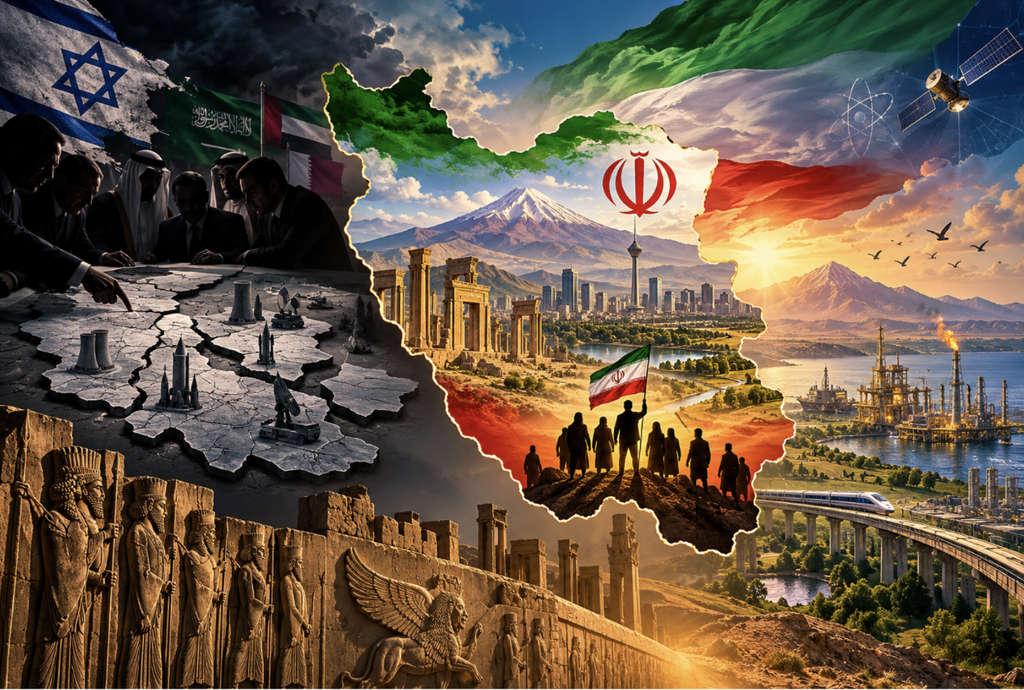
Their Problem Is Not the Islamic Republic; It Is Iran’s Capacity to Regenerate Power
The author goes on to make a point that many patriotic Iranian political forces have repeatedly emphasized.
He writes:
“The central issue goes beyond the nuclear program, ballistic missile stockpiles, and networks of proxy forces. These are instruments and assets that can be disabled or destroyed to some extent.”
This admission is extraordinarily significant.
For years, Iranian and international public opinion has been told that the main problem Israel and certain countries in the region have with Iran is the Islamic Republic’s nuclear program. At times, the focus has been on ballistic missiles, and at other times, on Iran’s regional presence and the Islamic Republic’s support for its allied forces.
But the author clearly states that even the destruction of these capabilities would not resolve the problem.
Why?
His answer is even more important than the question itself:
“But these capabilities emerge from a large country with a vast population, energy reserves, scientific and industrial infrastructure, an extensive geographical territory, and military institutions that have accumulated experience and developed capabilities over decades.”
This sentence deserves to be read repeatedly.
The author has correctly recognized that Iran’s power is not merely the product of the policies of a particular government or a collection of military equipment. Iran’s power is rooted in the country’s historical, geographical, human, and economic existence.
Iran is a country with a vast territory, a large population, enormous oil and gas resources, a strategic position connecting Central Asia, the Persian Gulf, the Caucasus, and the Indian Ocean, an educated workforce, industrial and scientific infrastructure, and accumulated experience developed over decades.
These sources of power do not disappear with a change of government or even the overthrow of a political system.
The author himself points to this very reality:
“The loss of facilities, leaders, and weapons cannot eliminate technical knowledge or destroy the capacity for reconstruction. A tool may be broken, but the underlying machine remains capable of producing a replacement.”
What is this “underlying machine”?
The underlying machine is Iran itself: a country with all its historical, human, scientific, economic, industrial, military, and geographical capacities.
And it is precisely at this point that we must become attentive to the logic underlying the article.
If the nuclear program can be halted, military facilities can be bombed, commanders can be assassinated, and missile equipment can be destroyed, yet the capacity to reproduce all these capabilities remains intact, then, from the perspective of those who regard Iran’s power as a permanent threat, the central issue is no longer these instruments.
The central issue is Iran’s national capacity to generate power itself.
From Containing the Islamic Republic to Containing the Structure of Iran’s National Power
In another section of the article, the author emphasizes:
“The issue therefore shifts from disarmament to the structure of the state; from who governs Iran to how the sources of power within the country are administered and managed.”
This may be the most important political sentence in the article.
The author is no longer merely calling for restrictions on a weapons program or changes in a government’s behavior. He shifts the issue to the structure through which Iran’s sources of power are administered.
In other words, even if the Islamic Republic were to disappear and an entirely different government were to come to power, the problem would still remain unresolved from the author’s perspective.
He explicitly writes:
“Replacing the regime without changing the way power is managed may soften the political tone, but it provides no guarantee that a different course will be pursued.”
He then continues:
“Geography, national interests, and potential capabilities do not disappear with a change of leaders. Long-standing regional ambitions will likely reemerge, except that this time they will be expressed in nationalist rather than revolutionary language.”
The political meaning of this statement is very clear.
From the author’s perspective, even the emergence of a nationalist, secular, nonreligious government, fundamentally different from the Islamic Republic, would not necessarily resolve the problem that Iran’s opponents have with its power.
This is because such a government might also seek to use Iran’s natural resources, scientific capabilities, industrial capacity, population, and geographical position to become a major regional power.
At this point, it is no longer possible to attribute all the concerns raised in the article to the ideology of the Islamic Republic, its religious policies, or its support for regional groups.
The issue concerns the capacity of a nation-state to become an independent and influential power.
This is precisely the point that many of us have repeatedly emphasized: the conflict over Iran’s power cannot be reduced solely to disagreements with the Islamic Republic.
Decentralization or the Weakening of National Power?
After describing the sources of Iran’s power, the author proceeds to present his proposed solution.
He writes:
“Extensive decentralization or federalism, and possibly even confederal arrangements, if adopted through national consent and constitutional agreement, could limit the center’s monopoly over wealth and decision-making, grant different regions greater authority over resources and financial affairs, and create institutional constraints on the use of national capabilities for foreign adventures.”
Here, we must examine the issue more carefully.
Federalism and decentralization are not, in themselves, synonymous with partition, nor do they necessarily lead to the weakening of a country. There are powerful and territorially unified countries in the world that are governed through federal structures. Democratic decentralization can also serve as a means of expanding public participation, eliminating discrimination, and distributing power and wealth more equitably.
But the fundamental issue in this article is the motivation and objective that the author presents for such changes.
He does not examine decentralization within the framework of expanding democracy, securing citizens’ rights, or addressing historical inequalities. Rather, he introduces it as an instrument for making it more difficult to mobilize Iran’s national resources for foreign and military policy.
In other words, his primary concern is not how the Iranian people can enjoy greater freedom and political participation, but how the concentration of power and the Iranian state’s ability to utilize the country’s resources can be restricted.
The difference between these two perspectives is fundamental.
In one perspective, decentralization is a means of strengthening democracy, national solidarity, and citizens’ participation in governing the country.
In the other, decentralization becomes an instrument for restricting a country’s capacity to exercise national power.
These two must not be confused.
Of course, the author does not explicitly call for the partition of Iran. He even warns about the dangers of the country’s chaotic collapse and emphasizes that structural changes must take place with the consent of the Iranian people.
Nevertheless, proposing federalism and even confederalism in an article whose principal objective is to prevent the regeneration of Iran’s power raises serious questions.
Is the ultimate objective to strengthen the rights of the people and their democratic participation, or to restrict Iran’s ability to become an independent and influential power?
Does the author seek a democratic and powerful Iran, or an Iran whose political structure prevents the concentration and utilization of its national capabilities?
The answers to these questions must be sought within the overall framework of the article’s argument.
Is a Large and Powerful Iran Acceptable to Its Neighbors?
The author repeatedly refers to Iran’s vast territory, population, energy reserves, scientific and industrial capabilities, and the experience of its military institutions.
But the question is why these characteristics should primarily be presented as sources of threat.
Is having a large population a crime?
Are possessing enormous oil and gas reserves, a strategic geographical position, or scientific and industrial capabilities inherently threats to other countries?
Should Iran be deprived of the ability to produce advanced technology, develop defense industries, or maintain its deterrent capabilities simply because certain governments in the region are concerned about the emergence of a powerful Iran?
None of these characteristics is inherently threatening. What can create a threat are expansionist policies, the unlawful use of force, interference in the affairs of other countries, and the absence of oversight and accountability in military decision-making.
But if, instead of criticizing such behavior, a country’s national capabilities themselves are presented as the principal problem, the boundary between opposing the policies of a government and opposing the power of that country becomes blurred.
In Iran’s case, this distinction is of vital importance.
Iran has the right to be a large, territorially unified, advanced country, possessing modern industries and defense capabilities proportionate to its security needs.
No foreign country has the right to determine Iran’s political and territorial structure according to its own security considerations.
The Illusion of Changing the Behavior of Adversaries Through Submission and Retreat
We must now ask those who imagine that Iran’s security and territorial integrity can be guaranteed through repeated retreats, surrendering strategic capabilities, restricting defense industries, and accepting the escalating demands of foreign powers: Have they considered the consequences of such a policy?
If the issue for those opposed to Iran’s power is merely the nuclear program, negotiations can be conducted over technical limitations, international monitoring, and mutual guarantees.
If the issue is ballistic missiles, discussions can take place concerning regional security, mutual deterrence, and arrangements for preventing war.
If the issue is the Islamic Republic’s regional policies, agreements can be reached concerning noninterference, mutual respect for national sovereignty, and mechanisms of collective security.
But if the central issue, as certain sections of AlKetbi’s article suggest, is Iran’s enduring capacity to regenerate power, then no limited retreat and no agreement concerning a specific program can, by itself, alleviate the concerns of those who fundamentally oppose the emergence of a powerful Iran.
Under such circumstances, a policy of submission and unilateral retreat not only provides no guarantee of security, but may also create the conditions for further pressure by weakening the country’s deterrent capabilities.
Of course, this does not mean rejecting diplomacy and negotiations.
On the contrary, Iran needs active diplomacy, balanced relations with its neighbors, and the reduction of regional tensions more than ever.
But diplomacy can serve national interests only when it is based on preserving the country’s independence, security, and fundamental capabilities, rather than on the assumption that gradually surrendering all instruments of power can secure the permanent satisfaction of its opponents.
An agreement that guarantees the security of one side while leaving the other defenseless against future threats cannot form the basis of a lasting peace.
The Danger of Confusing the Islamic Republic with Iran
One of the greatest political mistakes is to equate Iran’s existence and national interests with the fate of a particular government.
The Islamic Republic is a political system; Iran is a historical, civilizational, and national entity that existed long before the Islamic Republic and will continue to exist after it.
One can be a serious critic of the Islamic Republic’s domestic and foreign policies, oppose many of its decisions, and demand fundamental changes in the country’s governing structure, while simultaneously defending Iran’s independence, territorial integrity, and defensive and scientific capabilities.
These two positions are not only compatible but can also complement each other from the standpoint of national interests.
What must not be forgotten is that the destruction of Iran’s scientific, industrial, economic, and military infrastructure is not merely the destruction of the Islamic Republic’s assets.
This infrastructure belongs to the Iranian nation and to future generations.
The country’s scientists, engineers, specialists, skilled workers, research centers, industries, and natural resources are not the assets of a temporary government; they are national resources and the product of the efforts of successive generations of the Iranian people.
Weakening or destroying these capabilities can leave consequences for the lives of the people and the country’s future for decades.
For this reason, those who link opposition to the Islamic Republic with support for foreign military attacks, the destruction of national infrastructure, or the weakening of Iran’s defensive capabilities must answer this question: How is a free, independent, and prosperous Iran supposed to be built after such devastation?
Does AlKetbi’s Article Reflect the Strategy of Israel and Certain Persian Gulf States?
Although Salem AlKetbi is only an Emirati political analyst and his article was published in an Israeli newspaper, this alone does not prove that his views represent the official policies of the government of the United Arab Emirates, Israel, or other Persian Gulf countries.
Nevertheless, it must be recognized that the content of this article may reflect the strategic thinking of at least some elements within the leadership of Israel and the countries of the Persian Gulf region who examine the Iranian question beyond the Islamic Republic and within the framework of the long-term regional balance of power.
This is why, in my opinion, the article and the perspective it presents deserve serious examination.
If, within such a framework, Iran’s national power is defined as a potential threat regardless of the nature of its government, then it is natural that merely changing the regime or altering temporary policies would not be sufficient from the perspective of those who advocate this approach.
In that case, the discussion would concern the structural containment of Iran’s power.
And it is precisely here that vigilance is necessary.
We must not allow concepts such as democracy, the rights of ethnic groups, decentralization, and reform of the governing structure to become a cover for programs whose real objective is to weaken the country’s national solidarity and strategic capabilities.
Concluding Remarks: The Target Is Iran’s Historical Capacity to Remain Powerful
The significance of Salem AlKetbi’s article lies in the fact that, perhaps contrary to the author’s intention, it reveals one of the fundamental dimensions of the conflict over Iran’s power.
He demonstrates that even if Iran’s nuclear program is restricted, its ballistic missiles are destroyed, its regional networks are dismantled, and even the Islamic Republic falls, the fundamental foundations of Iran’s power will remain.
This is because Iran will still be a large country with a vast population, extensive natural resources, a strategic geographical position, scientific and industrial infrastructure, and accumulated experience that can once again enable it to rebuild its lost capabilities.
This is the reality that must stand at the center of every serious discussion concerning Iran’s national security.
If there are those who fundamentally oppose Iran becoming powerful, regardless of the nature of its government, no degree of unilateral retreat or compromise can guarantee that they will one day cease exerting pressure on Iran.
In response to such a perspective, our answer should not be military adventurism, isolationism, or the rejection of diplomacy. The answer must be to preserve and expand the sources of national power, strengthen solidarity among the people, reform ineffective structures, advance scientific and industrial development, and establish credible deterrence alongside peaceful and balanced relations with the world.
It must be remembered that Iran’s nuclear facilities, defense industries, energy resources, and scientific and industrial infrastructure are not the property of a government; they are part of the historical wealth of the Iranian nation.
Governments come and go, but Iran must endure: independent, territorially unified, prosperous, and powerful.
And if one fundamental lesson can be drawn from AlKetbi’s article, it is that the problem some of Iran’s opponents have may not be merely the Islamic Republic, the nuclear program, or ballistic missiles, but rather Iran’s historical ability to regenerate power and preserve its independent position in the region.
Therefore, defending Iran and its national capabilities must not be equated with defending the Islamic Republic.
The issue is not the future of a government; the issue is the future of Iran, our homeland, our people, and a civilization that must be preserved for future generations.
Reza Fani Yazdi
October 14, 2026
The original English article discussed in this critique can be found here: