Reza Yazdi
Posted on 04/23/2026
Although in the past Oman often played the role of mediator between Iran and United States at many critical moments, and due to its particular position was regarded as a small, cautious, and largely neutral country—more a facilitator of dialogue than a decisive actor—the entry of Pakistan as mediator changes the nature of the equation. Unlike Oman, Pakistan is not merely a host or intermediary; it is a country with a large population, a powerful military, nuclear capability, deep ties with Saudi Arabia and the countries of the Persian Gulf region, as well as strategic relations with global powers. For that reason, Pakistan’s involvement can be both an opportunity and a threat: an opportunity if it helps reduce tensions and create balance, and a threat if it leads to the formation of a new alignment against Iran’s interests.
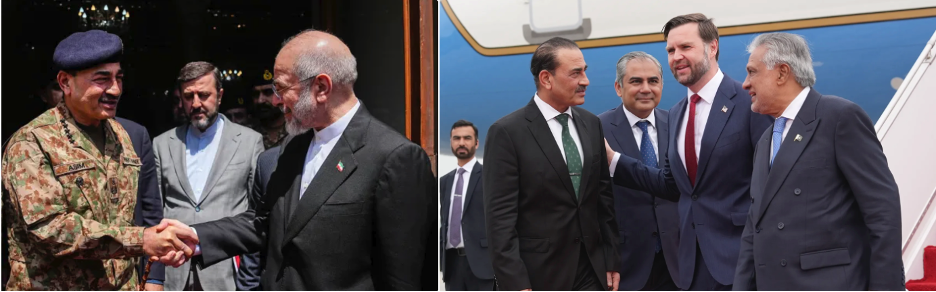
Pakistan’s involvement is both an opportunity and a threat: an opportunity because Pakistan has relations with Iran, the United States, Saudi Arabia, and the Gulf countries, and can therefore open channels of dialogue; a threat because if Pakistan’s role shifts from “mediator” to “security guarantor for the Gulf Arabs,” it could become a new instrument of pressure against Iran.
Pakistan has now emerged as a mediator because it has military and security ties with the United States, shares a border and common interests with Iran, and also maintains deep financial, labor, and military relations with Saudi Arabia and the countries of the southern Persian Gulf. In the latest round of talks, we saw that Islamabad was both the host and the preferred option of both sides for hosting U.S.-Iran negotiations, while Pakistan’s army chief, Asim Munir, also played a key role in efforts to revive the talks.
But the more important issue is the defense pact between Pakistan and Saudi Arabia. Analytical sources say that this pact, in September 2025, formalized the long-standing military relationship between the two countries and may even contain a clause similar to “an attack on one is an attack on both”; although the full details and the extent of any practical commitments—especially in the nuclear sphere—remain unclear.
Therefore, the central concern is this: if Pakistan serves only as host for dialogue, it could be beneficial; but if Pakistan becomes the military pillar of a new Gulf security order, then it would represent a strategic danger for Iran. In that case, Pakistan would no longer be merely a “mediator,” but part of the balancing strategy of Saudi Arabia and the Gulf states against Iran.
In my view, Iran must approach this issue carefully and with full caution: it should neither close the door to Pakistani mediation, nor allow Pakistan to become institutionalized in the role of a security guarantor against Iran in this region. Iran’s red line should be that no regional or extra-regional power—whether the United States, Israel, or Pakistan—should decide the security of the Persian Gulf in place of the Gulf’s littoral states.
In one sentence: if Pakistan serves as a bridge for dialogue, it is an opportunity; but if it is to become the military arm of the security order of Saudi Arabia and the southern Gulf states, then for Iran it would not be a mediator, but a serious threat to the future order and security of this region.