Four Billion Dollars in Aid to Israel: The Symbolic Significance of a Decision and the Reality of U.S. Military Expenditures in the Region
One of the most important issues raised in the run-up to the U.S. elections was the question of American financial and military assistance to Israel. In particular, just one day before the elections, Trump raised the possibility of cutting approximately four billion dollars in annual U.S. aid to Israel. In my view, this issue deserves to be examined beyond its electoral and propaganda dimensions.
We all know that Israel is a wealthy country with a large economy and considerable financial and military capabilities. Therefore, although four billion dollars is by no means an insignificant amount, it is not a decisive sum when compared with Israel’s overall financial and military resources and the extensive support it receives from the United States.
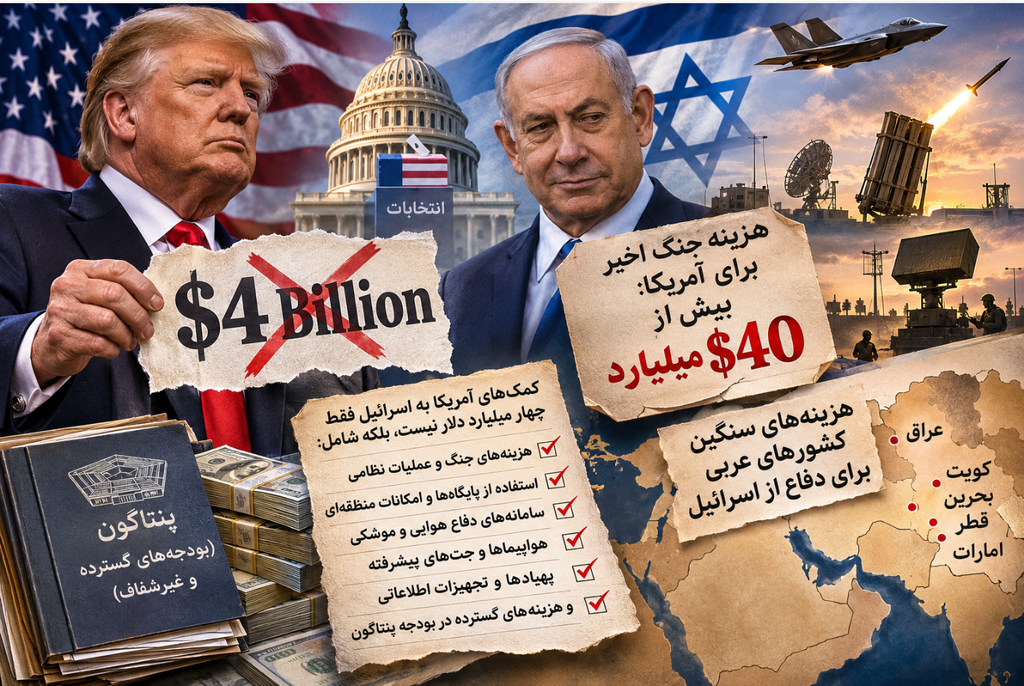
The fundamental point is that the actual cost of U.S. military support for Israel is not limited to these four billion dollars. This annual assistance represents only the visible and officially acknowledged portion of a much larger set of expenditures that the United States incurs, directly and indirectly, to maintain Israel’s military superiority and defend it in the region.
To understand the true scale of this issue, we need only look at the recent Israeli-American war against Iran—a war initiated by Israel, in which the United States subsequently became directly involved. My estimate is that the direct and indirect costs of this war to the American side exceeded forty billion dollars. If this estimate is correct, the United States spent, during this war alone, the equivalent of more than ten years of its annual four-billion-dollar military assistance to Israel.
But the issue does not end there.
Another substantial portion of the costs of this war has been borne, directly or indirectly, by the Arab countries of the region—countries that did not initiate the war and had no compelling reason to become involved in such a military confrontation.
From Iraq and Kuwait to Bahrain, Qatar, the United Arab Emirates, and Jordan, a vast array of military facilities, bases, air-defense systems, missile capabilities, radar networks, and surveillance and reconnaissance systems were deployed or utilized within the framework of the U.S. military structure and its regional allies.
The United States also employed its most advanced fighter jets, military aircraft, drones, interception systems, and intelligence and operational equipment.
The fundamental question, then, is this: For what purpose were this enormous concentration of military capabilities, these extremely expensive weapons systems, and these staggering expenditures mobilized?
The answer is clear: a significant part of this military mobilization was devoted to defending Israel and preserving its military position against Iran.
The Arab countries of the region, which had not initiated the war themselves, effectively bore part of the costs of a conflict in whose initiation and escalation Israel and the United States played decisive roles. These costs were not limited to the use of military equipment. They also included the expenses associated with troop deployments, combat readiness, the interception of missiles and drones, the protection of military bases and infrastructure, and the economic and security consequences of the war.
If we take all these expenditures into account, we may be looking at figures equivalent to several decades of official annual U.S. assistance to Israel. Of course, determining the precise amount would require an independent and well-documented assessment of the war’s costs.
For this reason, those who are now focusing all their attention on the proposed elimination of four billion dollars in annual aid to Israel should not overlook a much larger reality: American support for Israel is not merely a budget line item; it is an integral part of the United States’ military, security, and strategic structure in the Middle East.
This structure does not change easily with a change of administration.
Whether Trump occupies the White House or another president from either the Republican or Democratic Party takes office, the experience of past decades demonstrates that successive U.S. administrations have consistently allocated extensive financial, military, intelligence, and diplomatic resources to preserve Israel’s position in the region.
Therefore, even if the official four-billion-dollar assistance package were eliminated, it would by no means follow that the United States had abandoned its military support for Israel or stopped spending money on its defense.
Such support could continue through other channels, ranging from the Pentagon’s operational budgets and joint defense programs to the deployment of American forces in the region, the provision of military equipment, intelligence cooperation, missile-defense systems, and emergency appropriations approved during wartime.
Moreover, the Pentagon’s financial and budgetary structure is characterized by considerable complexity and serious auditing problems. The repeated failures of the U.S. Department of Defense to pass financial audits raise important questions about the transparency of military expenditures and the ability to exercise effective oversight over all resources and programs. Of course, these problems do not mean that there is a complete absence of oversight or that all military expenditures are unaccounted for.
Nevertheless, the political and symbolic significance of raising the possibility of cutting four billion dollars in aid should not be underestimated.
In my view, the very fact that Trump, on the eve of the elections, finds himself compelled to raise the issue of reducing or eliminating financial assistance to Israel as an electoral issue is itself an indication of an important shift in the American political climate and public opinion.
This development suggests that unconditional support for Israel, which for decades was one of the almost unquestioned pillars of U.S. foreign policy, has increasingly become a subject of public debate, criticism, and electoral competition.
American public opinion, particularly among young people, students, progressive forces, opponents of war, and segments of political movements critical of Washington’s foreign policy, is increasingly questioning the financial, human, and moral costs of American support for Israel.
From this perspective, even raising the possibility of eliminating four billion dollars in military assistance can carry considerable political significance. It demonstrates that public pressure and changing voter attitudes are forcing politicians to address issues they would have been far less willing to question until recently.
However, we must distinguish between the symbolic and electoral significance of such a measure and its actual impact on U.S. military policy.
Four billion dollars may be highly significant from a political and public-relations standpoint, but compared with the tens of billions of dollars spent on war, troop deployments, military support, and the utilization of regional countries’ military facilities and capabilities, it represents only a small part of the overall picture.
For this reason, the real measure of a change in American policy toward Israel should not be sought merely in the reduction or elimination of an annual aid package.
The essential questions are these: Is the United States prepared to refrain from participating in Israel’s wars? Is it willing to restrict the use of its own military bases and facilities, as well as those of its allies, in support of Israeli military operations? Is it prepared to stop supplying weapons and equipment used in these wars? And, most importantly, is it willing to make its Middle East foreign policy independent of the requirements of maintaining Israel’s military superiority?
As long as the answers to these questions remain negative, eliminating four billion dollars in annual assistance, however politically and symbolically significant, cannot be regarded as an end to American military support for Israel.
Ultimately, the central issue is not four billion dollars, but rather the enormous military, economic, and political costs that the United States and its regional allies incur to maintain Israel’s position.
Therefore, if a genuine transformation in U.S. policy is to take place, it must be reflected in the structure and nature of American military and strategic support for Israel—not merely in the elimination of a single budget item whose costs may continue to be covered through other channels, under different designations, and potentially on an even larger scale.
Reza Fani Yazdi
November 4, 2026