America Against the World: Will Sanctions on Iran Trigger a Revolt Against Dollar Dominance?
The announcement of the Trump administration’s new sanctions policy against Iran, which U.S. Treasury Secretary Scott Bessent has referred to as an “Economic D-Day,” is, in my view, an issue that extends far beyond Iran and even beyond the current war and confrontation between Iran and the United States. If, as announced, the objective of this policy is the comprehensive expansion of secondary sanctions and to compel countries, banks, and companies around the world to sever their economic relations with Iran, then we are entering a new stage in the use of American economic power as a political weapon.
The United States, of course, has for years used the dollar, its banking system, its domestic market, and its dominant position in the global economy to exert pressure on other countries. But what makes the current development particularly significant is that this weapon is no longer being used solely against countries that Washington considers its enemies. What has happened in recent days in relations between the United States and Canada may be one of the clearest examples of this phenomenon.
Mark Carney, the Prime Minister of Canada, in one of his strongest recent statements against U.S. economic policy, explicitly declared that the United States has changed and is now using even “economic integration” and economic interdependence as a weapon. These words come from the prime minister of a country whose economy is perhaps more deeply intertwined with that of the United States than any other major economy in the world.
Therefore, the issue is not merely Iran.
The fundamental question is this: If the United States can turn Canada’s economic dependence into an instrument for exerting pressure on Canadian national sovereignty, what guarantee is there that tomorrow it will not use the same instrument against any other country?
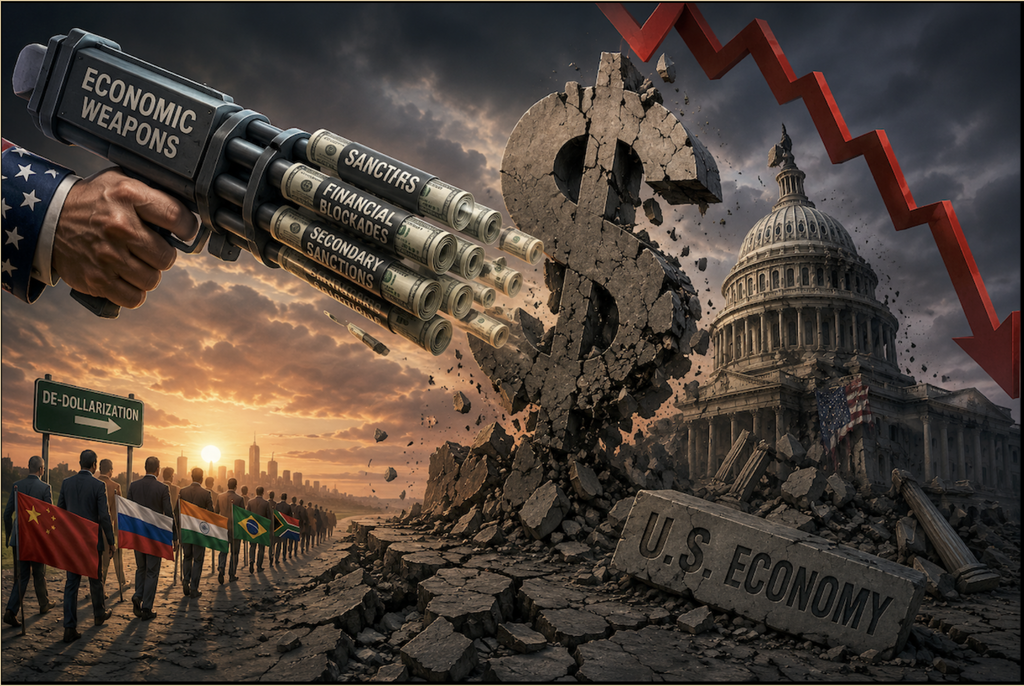
From this perspective, secondary sanctions against Iran could become a historic turning point. China, Russia, India, Brazil, the BRICS countries, and even America’s traditional allies must confront the question of whether their economic relations with the United States are meant to serve as a vehicle for development and mutually beneficial trade, or as an instrument that Washington can use whenever it chooses to dictate their relations with third countries.
China Faces a Historic Choice
In my view, the most important test of this policy will be China.
China today is Iran’s largest oil trading partner and, at the same time, one of the United States’ largest trading partners. If Washington can use the enormous volume of U.S.-China trade to compel Beijing to sever or restrict its economic relations with Iran, then the issue will no longer be merely a few million barrels of oil or a few billion dollars in trade with Iran.
The issue is much larger.
In that case, China would effectively have accepted that the United States can determine which countries Chinese companies, banks, and institutions may or may not do business with. In other words, a portion of China’s economic sovereignty would become contingent upon its access to the American market and the U.S. financial system.
For this reason, I do not believe China will easily retreat in the face of such pressure. Of course, we cannot say with certainty today that no Chinese company or bank will retreat. Large corporations, banks, and the Chinese government do not necessarily make their calculations in the same way. But at the strategic level, fully accepting the logic of U.S. secondary sanctions would impose costs on China that extend far beyond its relations with Iran.
The question is: Who determines China’s foreign and trade policy—Beijing or Washington?
Iran: A Testing Ground for an Economic Order
The stated objective of the new U.S. policy is to cut off Iran’s economic lifelines and force Tehran to retreat. In my view, however, this economic pressure must be understood within the broader context of the war and efforts to alter the structure of power in Iran—a process that could have extremely dangerous consequences for our country’s national sovereignty, independence, and territorial integrity.
Yet this is precisely where the great contradiction of this policy emerges.
In order to isolate Iran, the United States must threaten China, India, Russia, countries in the region, and numerous companies and financial institutions around the world. Consequently, the more comprehensive secondary sanctions become, the more what was initially supposed to be the “Iran problem” becomes a question of the economic sovereignty of other countries.
In other words, in attempting to isolate Iran, Washington may inadvertently force a growing number of countries to confront the question of how they can reduce their dependence on the dollar, the U.S. banking system, and the American market.
From Tehran to Ottawa: A Common Question
This is precisely where the significance of the Canadian prime minister’s recent remarks becomes apparent.
When the prime minister of one of America’s closest historical allies says that Washington is using economic dependence and integration as a weapon, and that Canada must diversify its economic relations, the issue of America’s “economic weapon” can no longer be dismissed simply as a grievance voiced by Iran, Russia, or China.
If Canada, despite the extraordinary depth of its historical, political, and economic ties with the United States, has concluded that excessive dependence on the American economy can threaten its independent decision-making, it is only natural that the same question would arise with even greater urgency in Beijing, New Delhi, Brasília, and other capitals around the world.
The Beginning of a Larger Transformation
For this reason, I do not see the announcement of these sanctions merely as the beginning of another round of economic pressure against Iran.
We may be witnessing one of those moments whose historical significance will later prove far greater than it appeared at the time.
If the world’s major countries conclude that excessive dependence on the dollar, American banks, and the U.S. market could one day be weaponized against them, it is only natural that they will seek alternative mechanisms: trade conducted in national currencies, independent payment networks, banks operating beyond the reach of U.S. sanctions, and an expansion of South-South economic relations.
This process will not happen overnight, nor will the dominance of the dollar end because of a single decision or a single crisis. But policies of this kind can strengthen the incentives for moving in that direction.
From this perspective, what Scott Bessent today presents as an “Economic D-Day” against Iran may acquire an entirely different meaning in the future.
Perhaps this will not merely be an “Economic D-Day” against Iran; perhaps it will be remembered as one of those days when the world moved closer to the conclusion that, in order to preserve its political independence, it must achieve greater independence from the economic instruments of the United States.
And if that happens, the historical contradiction at the heart of this policy will become clear: an instrument designed to consolidate American economic power and break Iran’s resistance could itself become one of the forces accelerating other countries’ efforts to reduce their dependence on that very economic power.