From “Surveillance Capitalism” to “The Coming Wave”
When Technology Ceases to Be a Tool and Becomes a Force Beyond Control
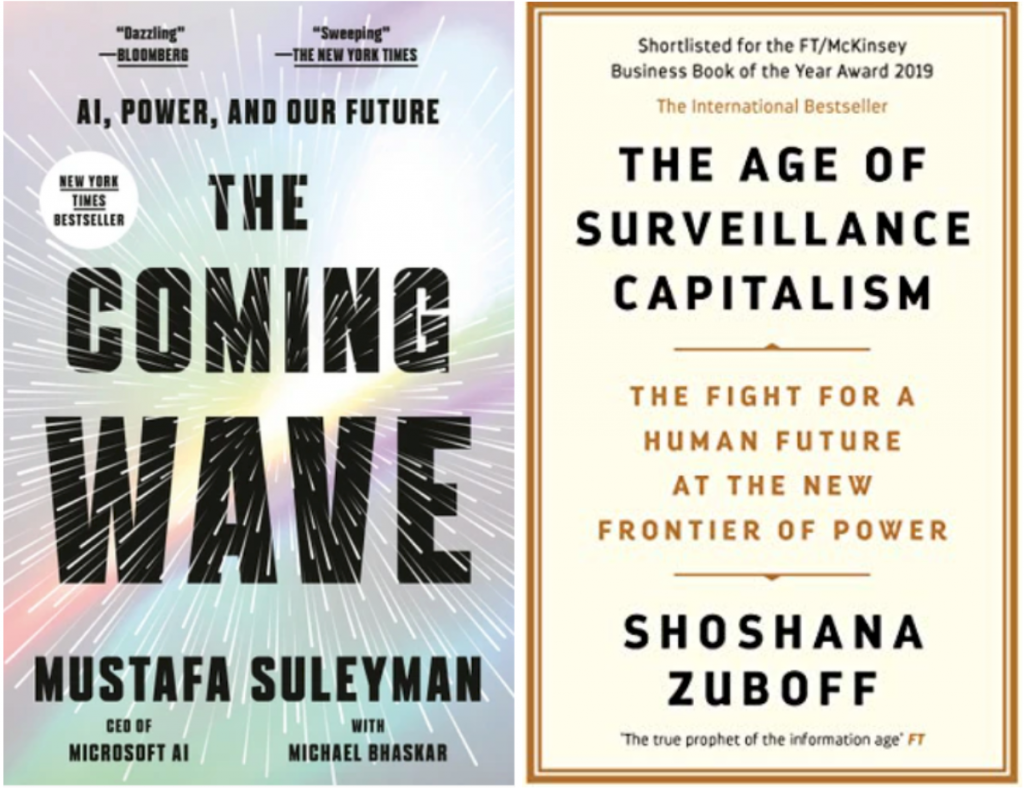
Some time ago, I read The Age of Surveillance Capitalism by Shoshana Zuboff. At first glance, it may appear to be merely a critique of large technology companies. But the further one reads, the clearer it becomes that the issue runs far deeper than that. Zuboff is in fact describing the emergence of a new kind of power—a power held neither by governments nor by the people, but by structures that understand human behavior, predict it, and gradually shape it.
Some time later, I read The Coming Wave by Mustafa Suleyman and Michael Bhaskar. This book looks at the future from a different angle, yet with a similar concern. Suleyman speaks of a world in which artificial intelligence, biotechnology, and complex systems will not merely transform our lives, but may ultimately escape our control.
The more I reflected on these two books, the more I saw a striking similarity between them.
Both are talking about the same thing:
A moment in history when human beings have created tools that are no longer fully in their hands.
Part One: Surveillance Capitalism — Silent Domination
Zuboff shows how companies such as Google and Facebook gradually moved from providing services to extracting data.
At first, everything seemed simple:
A search engine.
A social network.
A free service.
But behind these services, a new logic was taking shape:
The conversion of human experience into data, and the conversion of data into profit.
We believed we were users.
But in reality, we became a resource to be extracted.
These companies were not merely interested in knowing what we do. They wanted to predict what we would do—and even more importantly, to create the conditions in which we would do what they wanted.
This is where a fundamental shift occurs:
From observing behavior to shaping behavior.
And this is precisely the point that Zuboff sees as dangerous.
Because once human behavior becomes engineerable, freedom no longer remains freedom in its true sense.
Now let us turn to The Coming Wave by Mustafa Suleyman and Michael Bhaskar, and examine the central points emphasized by its authors. Then we can compare these two books—works which, in my view, each from a different but highly valuable perspective, address a phenomenon whose effects have cast a shadow from the past to the present over the way human beings live, think, decide, and understand the world. They also warn of dangers that may confront human life, rational thought, and the future path of civilization.
The Coming Wave — Technology Escapes Containment
In The Coming Wave, Mustafa Suleyman speaks of a future in which technology advances at a speed far greater than our ability to control it.
He points to two key domains:
- Artificial Intelligence
- Biotechnology
In this new world, the issue is not merely that corporations or governments possess power.
It is that technology itself reaches such a level of complexity that controlling it becomes difficult—or even impossible.
If in Zuboff’s book the human being is under surveillance, in Suleyman’s book the human being stands before a system that even its creators may no longer be able to restrain.
Here we are no longer dealing with a “project.”
We are confronting a “wave”—a wave that, if we do not learn how to control it or resist it, may carry us away.
From Human Control of Technology to Technology’s Control of Humanity
This is where the deepest similarity between the two books lies.
In The Age of Surveillance Capitalism, power is exercised through data and algorithms.
In The Coming Wave, power is exercised through complex and autonomous technological systems.
But the result in both cases is the same:
A reduction in humanity’s ability to control its own destiny.
In both narratives, we encounter a gradual process:
First, technology enters our lives as a tool.
Then, it becomes a structure.
Finally, it becomes a force that shapes us.
A Shared Concern: Democracy in Danger
Both authors, in different ways, arrive at a common concern:
Can democracy survive in the face of this wave?
When:
- Human behavior can be predicted and manipulated
- Information is monopolized by a few concentrated powers
- Technology advances at a speed beyond control
What meaning will collective decision-making still have?
Do people truly choose?
Or have their choices already been engineered in advance?
An Important Difference Between the Two Perspectives
Despite their similarities, there is also a significant difference.
Zuboff focuses more on the power of corporations, while Suleyman emphasizes the nature of technology itself.
This difference may be summarized as follows:
- In Zuboff’s view, the problem can be partially controlled through regulation and limiting corporate power.
- In Suleyman’s view, even if intentions are good, the speed and inherent nature of technology may still move beyond control.
A Warning for Our Historical Moment
What these two books offer us is not merely academic analysis.
They are a serious warning to all of us in this new historical era.
We are living in a time when:
- Our data has become capital
- Our behavior has become engineerable
- Technology is crossing the boundaries of human control
Perhaps the greatest question of our age is this:
Do we still control technology?
Or is technology gradually shaping our very existence?
And if the second answer is true,
Then we must ask:
How much time do we have left to change this path?
And can this path, in fact, still be changed?
Reza Fani Yazdi — April 24, 2026