The Historical, Philosophical, and Theological Roots of Islamophobia
Samuel P. Huntington, an American political scientist and the author of the well-known book The Clash of Civilizations, argued in 1996—during the post–Cold War period, when the Soviet Union had collapsed and many thinkers were trying to explain the new world order—in response to the question of what the main source of future global conflicts would be. He maintained that in the post–Cold War world, the principal source of conflicts would be not ideology and economics, but cultural and civilizational differences among various societies. In Chapter Two of the book, under the subtitle “The Nature of Civilizations,” he points to an issue that many overlook: the West’s power to organize violence in its conquest of the world. He expresses it as follows:
“The West conquered the world not by the superiority of its ideas or values or religion … but rather by its superiority in applying organized violence. Westerners often forget this fact; non-Westerners never do.”*
*This quotation appears in Samuel Huntington’s The Clash of Civilizations and the Remaking of World Order. It is found specifically in Chapter 2, titled “The Nature of Civilizations,” on page 51.
This sentence is one of the key points in Huntington’s analysis of the history of power in the world. He emphasizes that the expansion of Western influence and domination over the past several centuries has been less the result of cultural or ideological superiority than the product of the West’s ability to organize military power, war technology, and political and military structures.
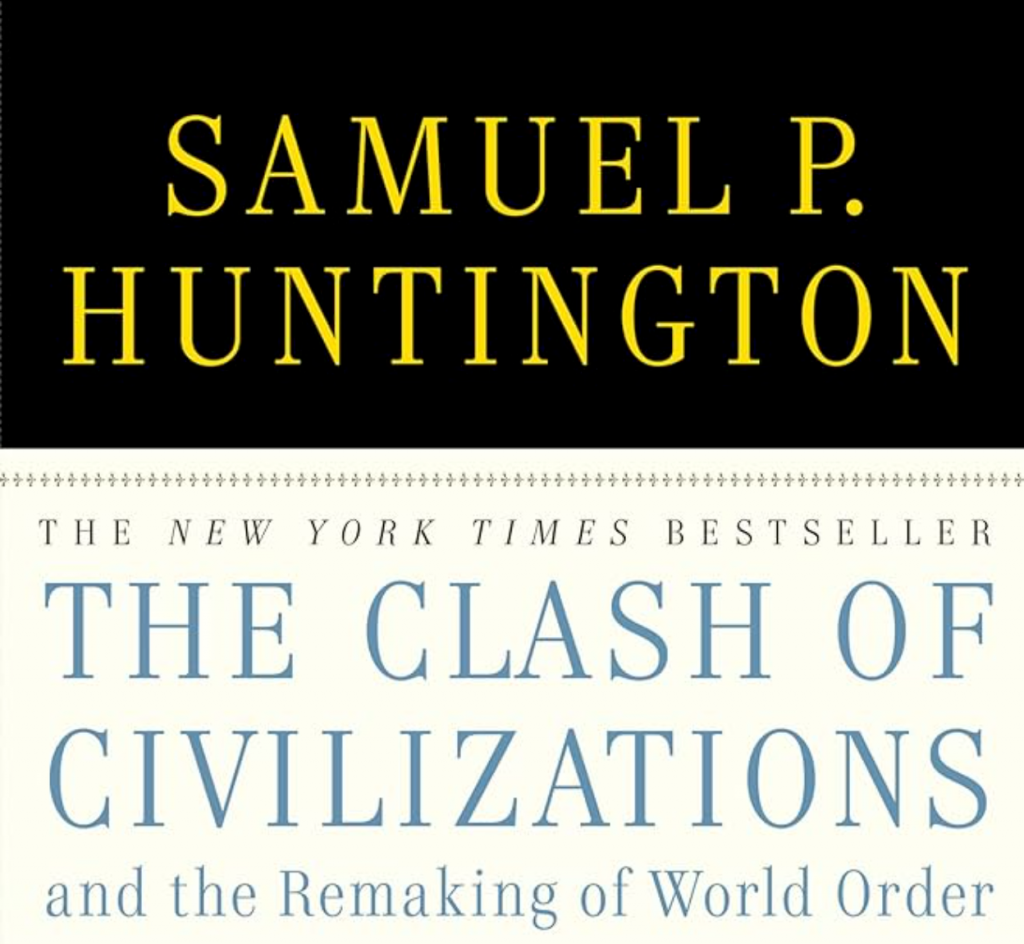
In The Clash of Civilizations, Huntington argues that after the end of the Cold War, the nature of global conflicts would change. In his view, the main sources of future tensions and conflicts would be neither ideological disagreements (such as capitalism and communism) nor merely economic competition, but deep cultural and civilizational fault lines. Within this framework, he divides the world into several major civilizational spheres—including Western, Islamic, Confucian, Hindu, Orthodox, and other cultural realms—and believes that many future conflicts will take shape along the borders of these civilizations.
From Huntington’s perspective, one of the reasons for the sensitivity and distrust that many non-Western societies feel toward the West is precisely this historical experience of the West’s expansion of power through colonialism, wars, and military domination—an experience that, in his words, has remained in the historical memory of non-Western nations and continues to shape their view of the global order.
If Samuel P. Huntington argued in 1996, in The Clash of Civilizations, that in the post–Cold War world the main fault lines would no longer be ideological or economic, but would form along civilizational borders—and if in that same book he reminded us that the historical expansion of Western power has been driven less by the “superiority of ideas and values” than by the capacity to organize power and violence—today we can see how this theoretical framework has been translated into the political discourse of some Western leaders and turned into a language of practical policy. At the beginning of the twenty-first century, when George Bush, during the war in Iraq, used the expression “crusade,” many took it as a sign of the return of civilizational language to international politics. Now, two decades later, the same logic appears even more explicitly in Marco Rubio’s remarks at the Munich Security Conference. Rubio stresses: “We are part of a civilization—the Western civilization,” and he warns that the United States does not want to be the “polite guardian of the West’s gradual managed decline.” He calls on Europeans to align themselves with Washington’s power-centered policy and warns: “If necessary, we are prepared to do it alone…” and also, “This path… is the path we ask you in Europe to join.”

In reality, what Huntington had presented as a theoretical analysis of civilizational competition is now being articulated more openly in the language of global politics and security. Within the same framework, other leaders have also used similar terms. For example, Benjamin Netanyahu has repeatedly emphasized that Israel stands “on the front line of defending Western civilization” against forces he considers a threat to that civilization. In Europe as well, some political leaders—especially in debates related to immigration and security—have spoken of “protecting civilization” or “the European way of life.” Taken together, these positions show that the discourse of “civilizations,” which Huntington presented in the 1990s as an analytical framework, gradually entered the official language of politics in subsequent decades and is now being used more directly in the speeches of some Western leaders—a discourse in which “civilization,” “identity,” and “power” have become ever more tightly linked.
Given this intellectual and political background, perhaps we can now approach the phenomenon of Islamophobia and “de-Islamization” over the past few decades with greater clarity and examine its historical and civilizational roots. When theories like the “clash of civilizations” are introduced at the level of analysis and then translated in the political discourse of some Western leaders into the language of “defending civilization” or “preserving Western identity,” it is natural that perceptions of the Muslim world will be framed within the same civilizational logic. In such an atmosphere, Islam is defined not merely as a religion, but sometimes as a “civilizational other”—a definition that can provide the ground for the formation or reinforcement of Islamophobic attitudes in political, media, and cultural arenas.
For this reason, studying Islamophobia cannot be limited to analyzing contemporary events alone; it requires attention to deeper historical, intellectual, and civilizational layers—layers in which political rivalries, historical memories, religious and cultural narratives, and ideological understandings of “civilizations” are interwoven. Understanding these contexts can help clarify how, in recent decades, some intellectual and political currents in the West—consciously or unconsciously—have reproduced discourses in which Islam and the Muslim world are positioned as the “civilizational other,” thereby fueling new waves of Islamophobia and de-Islamization at the global level.
In recent decades, a new wave of Islamophobia and de-Islamization has taken shape in some Western societies. In this process, certain intellectual and media currents—including groups associated with psychological and propaganda warfare—have played an active role. Part of these discourses has sought to connect hostility toward Islam to a kind of identity-stripping of Iranians, such that Iranian identity—an identity that, over long centuries of this land’s history and civilization, has become intertwined with cultural and religious elements, including Islam—has itself become the target of criticism and attack.
However, such approaches have not been limited to Iran and cannot be. In many cases, the scope of these discourses has also expanded to other Islamic countries and Muslim communities across the world, and it appears that this trend may take on even broader dimensions in the coming years. For this reason, examining the roots, motivations, and consequences of these intellectual currents is of great importance for a better understanding of the cultural and political transformations of the contemporary world.
One important task is to examine to what extent phenomena such as Islamophobia, de-Islamization, and hostility toward Islam are rooted in the ideas of ancient Greek thinkers, European philosophers and intellectuals, and also in the teachings and traditions of other religions such as Judaism and Christianity. Each of these religions has had its own particular interpretations and beliefs regarding concepts such as equality, justice, and salvation. In this context, it is necessary to clarify to what extent Islam’s perspective on these matters differs from theirs, and in what cases it aligns with or diverges from what is now known as “human rights”—including the fight against discrimination, the struggle against racism, and efforts to achieve social justice. Attention to these issues helps us better understand the phenomenon of hostility toward Islam, which over the past centuries—whether in ecclesiastical traditions, among certain Jewish intellectual currents, or among Greek thinkers and even some Western philosophers—took shape and later, especially in the seventeenth and eighteenth centuries, acquired new formulations.
Within the same framework, another important question arises: how Islam managed to expand across wide parts of the world—from Spain and parts of Italy to areas near Vienna, as well as in Africa, the Arab lands of Asia, and Central Asia. We must examine what factors, slogans, and motivations enabled Islam to gain influence in these regions and secure a lasting place. To what extent was this expansion linked to ideas such as the rejection of racial discrimination, the pursuit of justice, and respect for the rights of others? Issues such as the rights of religious minorities and the status of the ahl al-dhimma must also be examined in comparison with other religions, especially Christianity and Judaism—what those religions’ views were regarding followers of other beliefs or those without a particular religion, what their religious rulings were concerning them, and, on the other hand, what regulations and rulings Islam offered in this regard. Addressing this set of questions can lead to a clearer understanding of today’s situation—namely, the view of Islam and Muslims that has taken shape in Western societies, both among some intellectuals and among currents rooted in Christian and Jewish traditions, and that we now hear from the mouths of political leaders in these countries and see ever more openly displayed in their political documents and speeches.
Islamophobia cannot be regarded merely as a phenomenon that emerged in recent decades as a result of the performance of contemporary media. It has deep roots in the history of Western thought and is the product of multiple layers of historical, philosophical, and religious attitudes. From the ancient Greeks’ conception of the “other” and the division of humanity into “Greek” and “barbarian,” to the exclusivist theologies of certain Jewish and Christian traditions, and then to the Orientalist discourse of modernity and colonialism—all have played a role in shaping a durable, and at times hostile, outlook toward Islam and the Muslim world. In the contemporary era, this outlook has taken on new forms through theories such as the “clash of civilizations,” and then through the political language of certain Western leaders who speak of “defending Western civilization.”
My goal in this article is to show, through a comparative approach, why in many historical and intellectual narratives of the West, Islam has been portrayed as a “civilizational other” or even a threat to the West’s civilizational order. At the same time, I seek to explain how certain social and moral features of Islam—including its emphasis on justice, its rejection of racial distinctions, and its attention to the rights of religious minorities—contributed to its spread across wide parts of the world, a spread that extended from Spain and North Africa to the Middle East and Central Asia and led diverse peoples across three continents to become familiar with this religion and, in many cases, to adopt it.
The Need to Rethink the Roots of Islamophobia
Islamophobia in today’s world—whether in certain media outlets, in political and security discourses, or in far-right currents in Europe and America—is in fact the continuation of a historical process whose roots go back centuries. To understand this phenomenon, we must pay attention to several fundamental questions:
First, in ancient Greek thought, the “complete human being” was largely limited to the Greek citizen, while others were defined as “barbarians.” How did this outlook lead to the formation of the image of the “uncivilized foreigner”?
Second, in Jewish and Christian religious traditions, to what extent were the concepts of salvation and justice extended to all human beings? What were these religions’ views of non-believers, polytheists, or adherents of other faiths, and what place did they assign to them within the religious and social order?
And third, what different outlook did Islam offer regarding concepts such as human equality, social justice, and the rights of minorities? Why were these differences, in many historical periods, perceived as a civilizational challenge for the Greek-Byzantine world, the Christian Church, and later Europe?
Reflecting on these questions can show why, throughout history, Islam, on the one hand, encountered rapid expansion across vast regions of the world, and, on the other hand, faced fierce resistance and hostility from some of its political, religious, and civilizational rivals.
Ancient Greek Philosophy and the Formation of the Concept of the “Other”
In examining the historical roots of the West’s view of Islam, one of the starting points must be sought in the intellectual tradition of ancient Greece. In this tradition, a kind of anthropology took shape that drew a fundamental distinction between “us” and “the other.” The Greeks called themselves “Hellenes” and referred to those outside this cultural world as “barbarians.” This term did not simply mean “foreigner”; it carried a specific value judgment and was often used to describe peoples who, in the Greek view, lacked culture, rationality, or civilization. Such an understanding is reflected in the works of writers such as Homer, Herodotus, and Hesiod, and also in the thought of philosophers like Plato and Aristotle. Within this framework, the Greeks saw themselves as the embodiment of rationality and civilization, and Eastern lands—from Iran and Mesopotamia to Syria and Egypt—were sometimes depicted as territories predisposed to “Oriental despotism.” This kind of view, which later continued in Byzantine and European intellectual traditions, resembles what in the modern period came to be called “Orientalism.”
Aristotle and the Naturalization of Inequality
In Aristotle’s philosophy we can also observe an example of this hierarchical outlook. He defended the view that some human beings are naturally more suited to rule and others more suited to obey. In his view, slavery can, in certain cases, be part of the natural order of society, because some people lack the full capacity to manage an independent life. This understanding—according to which human inequality is interpreted as something natural—later influenced certain European intellectual traditions and, in various periods, was cited to justify different forms of social inequality and even slavery.
From a historical perspective, such a viewpoint helped form an image of the “other” in which peoples outside the Greek cultural world—especially in the East—were sometimes seen as lacking the rational and political capacities needed for self-government. This image was repeated in later European narratives about the non-Western world.
Plato and the Hierarchical Order of Society
In Plato’s thought as well, the ideal society is defined on the basis of a hierarchical structure. In The Republic, he considers society to be made up of three main classes: the ruling class or philosophers, the warrior class, and the producing class. From Plato’s perspective, each of these groups has a natural function, and justice is achieved when each person performs the role appropriate to them within society.
In this understanding, justice is less a matter of social equality than the preservation of order and harmony among the parts of society. Such a conception of social order influenced certain political and religious views in Europe over the course of history and contributed to the consolidation of hierarchical perspectives about society.
Byzantium and the First Intellectual Encounter with Islam
With the emergence of Islam in the seventh century CE, the Byzantine Empire—heir to a significant portion of the Greek intellectual legacy—encountered for the first time a newly emerging civilization that was rapidly expanding across vast territories. Some Byzantine writers and theologians, in trying to understand this new phenomenon, interpreted it within the framework of their own intellectual and religious concepts. In some texts from this period, Islam was sometimes introduced as an Eastern phenomenon different from the Christian tradition, and critical or negative interpretations were offered regarding its origins and nature.
Among the figures who wrote about Islam was the Byzantine historian Theophanes the Confessor, who presented accounts of Islam’s emergence in his historical writings. John of Damascus, an eighth-century Christian theologian, also analyzed Islam within the framework of Christian theological debates and regarded it as a kind of deviation from Christian teachings. These texts are among the earliest attempts by the Christian world to understand and interpret Islam, and they influenced later European literature about Islam.
Thus, the first intellectual encounter of the Christian-Byzantine civilization with Islam took shape in a context of philosophical and theological presuppositions whose roots go back to Greek and Christian traditions. These intellectual backgrounds later played an important role in shaping certain historical European perceptions of Islam.
The Theological Structure of Judaism and Christianity: Salvation, Religious Identity, and Drawing Boundaries with the “Other”
Alongside the philosophical legacy of ancient Greece, the religious traditions of Judaism and Christianity have also played a role in shaping certain historical perceptions of “insiders” and “outsiders.” In these traditions, concepts such as the “chosen people,” “salvation,” and “true faith” have been interpreted in ways that, in many historical periods, created clear boundaries between the community of believers and others. Over time, these boundary-drawings have sometimes produced various forms of distinction or religious discrimination in societies, and in some cases they influenced Europeans’ views of other religions.
Judaism and the Concept of the “Chosen People”
In parts of the Old Testament, the Israelites are introduced as the “chosen people,” a people within the framework of a covenant with God. In this theological framework, a special relationship is depicted between God and the people of Israel, and religious and social laws are also formed within this context.
This concept had important intellectual consequences in the history of Judaism. First, divine salvation and justice were defined primarily within the framework of that covenant. Second, Jewish religious laws, in many cases, drew a clear distinction between the Jewish community and other peoples. Nevertheless, throughout history different interpretations of this concept have been offered, and many Jewish thinkers have tried to reread it within a more ethical and human framework. Even so, in some historical narratives, this concept contributed to the formation of religious boundaries between “inside the community of believers” and “others.”
Christianity: The Universality of the Message and the Boundaries of Faith
From the beginning, Christianity presented itself as a universal religion, and its message was considered for all human beings. However, in many historical interpretations of the Church, salvation was ultimately regarded as dependent on faith in Christ and obedience to the Church’s teachings. As a result, those outside this framework—whether followers of other religions or even certain currents within Christianity—were sometimes regarded as heretical or outside the circle of faith.
In European history, these religious boundary-drawings sometimes led to serious conflicts and tensions. Examples such as the Crusades, the Inquisition, and historical discrimination against Jews are among the events that show how religious concepts could be reflected in political and social structures. Within this framework, the medieval Christian world often saw the world through a binary of “us” and “others”—a binary that later played an important role in shaping historical European literature and images in its encounter with the Islamic world.
Islam: The Universality of Justice, the Rejection of Racial Discrimination, and the Formation of a New Legal Order
Islam emerged in a historical environment whose social structures were intensely tribal and unequal. In many pre-Islamic Arab societies, tribal and racial prejudices played a decisive role, slavery was widespread, and women in some tribes had limited human rights. At the same time, in other parts of the world, major religions such as Judaism and Christianity were bound up with structures of political and social power. Under these conditions, Islamic teachings, by proposing a set of new moral and legal principles, offered a different vision of the human being, justice, and society.
Human Equality and the Rejection of Racial Superiority
One important principle in Islamic thought is the emphasis on the fundamental equality of human beings. In the Islamic tradition, this principle is reflected in the teachings of the Prophet of Islam as well as in religious texts; among them is the famous hadith stating that there is no inherent superiority of an Arab over a non-Arab except on the basis of piety and moral virtue. Such a viewpoint stood in contrast to many hierarchical outlooks common in the ancient world, in which race, ethnicity, or social status were considered criteria of superiority.
In the first Muslim community, we also see examples of social mobility that reflect this approach. Figures such as Bilal al-Habashi, Salman al-Farsi, and Suhayb al-Rumi—each coming from different ethnic and social backgrounds—found important positions within the Islamic community. This shows that, in practice as well, efforts were made to define new criteria for social standing.
Social Justice as a Religious Principle
In Islamic thought, justice is not merely a moral or philosophical principle; it is also presented as a religious obligation. Islamic teachings emphasize care for the needy, support for the poor, the prohibition of economic exploitation, and limiting the unjust accumulation of wealth. Institutions such as zakat and charitable giving were formed as tools for a more just distribution of resources within society. In Islamic sources, administrative corruption and abuse of power are also strongly condemned.
Within this framework, justice is defined not as the stabilization of social hierarchies, but as the creation of moral and social balance within society—a concept that in many Islamic texts is introduced as one of the primary objectives of the Sharia.
The System of Ahl al-Dhimma and Religious Coexistence
One important feature of the social order in many historical Islamic societies was the formation of a mechanism for coexistence with followers of other religions, known in Islamic jurisprudence as the ahl al-dhimma. These groups—including Jews, Christians, and in some regions Zoroastrians and Sabians—could preserve their religion within a legal framework and enjoyed protection of life and property. In many cases, they had freedom of worship, and in personal and religious matters they were judged according to their own religious laws.
Within this framework, a tax known as jizya was collected from them, and in return they were exempt from military service and received the protection of the government. In certain periods and places—for example in al-Andalus or parts of the Middle East—non-Muslims even attained important administrative or scholarly positions.
A Historical Comparison with Europe
In the Middle Ages, Europe faced complex developments in which church structures played a prominent role in political and social life. In some periods, there were religious restrictions and pressures against dissident religious or intellectual groups. By contrast, in parts of the Islamic world, a space emerged for the translation and transmission of Greek, Iranian, and Indian sciences and philosophy, and important scholarly centers took shape.
In the same periods, Jewish, Christian, and Muslim scholars worked alongside one another in cities such as Baghdad, Damascus, Cairo, and al-Andalus, and they made important contributions to the development of knowledge in fields such as medicine, philosophy, and mathematics. These interactions show that in parts of its history, the Islamic world was able to provide a space for cultural and scholarly exchange among different traditions.
Why Did Islam Spread? A Review of Several Key Factors
The rapid spread of Islam in the early centuries cannot be explained solely by military or political factors. A set of social, political, and intellectual conditions in the world at that time caused Islam’s message to attract attention across wide parts of Asia, Africa, and even Europe. Researchers usually point to several important factors in this process.
First, there were the social and political conditions of the world at that time. In many regions under the rule of large empires such as Byzantium and the Sasanian state, administrative structures had become worn out, heavy taxation placed great pressure on the population, and religious tensions existed between states and certain religious groups. In such an environment, a new religious message emphasizing justice, moral order, and social responsibility could seem understandable and attractive to many societies.
Second, there was the formation of a relatively orderly and clear legal framework in Islamic societies. Rules related to property, family, contracts, and taxation were organized within a relatively coherent system, which helped create a kind of administrative and social stability. In many regions, this legal order provided a clear framework for social life for various groups—including religious minorities.
Third, there was the formation of relatively effective governmental structures in the early Islamic period. Early Islamic governments were able to establish a broad administrative system in which a common administrative language, a relatively orderly tax system, and new managerial mechanisms took shape. This organization helped consolidate rule over vast territories and facilitated communication among different regions.
Fourth, there was the possibility of relative religious coexistence in many Islamic regions. In many cities of the Islamic world, followers of various religions—especially Jews and Christians—were able to live within defined legal frameworks and engage in economic, scholarly, or cultural activities. In some areas, this situation led different religious groups to view the new governments as a factor of social stability.
Fifth, there was scientific and cultural flourishing in major urban centers. Cities such as Baghdad, Damascus, Cairo, and Córdoba became important hubs for the translation and transmission of knowledge. Greek, Iranian, and Indian philosophical and scientific works were translated, and significant advances emerged in fields such as mathematics, medicine, astronomy, and philosophy. This intellectual dynamism helped raise the cultural level of society and attracted thinkers from diverse regions.
Finally, Islam’s moral and spiritual message—emphasizing concepts such as human equality, individual responsibility, social justice, and the rejection of racial superiority—was appealing to many people. These moral and spiritual elements, together with the historical and social conditions of that time, created the conditions for Islam to spread across vast regions of the world in a relatively short period.
Modern Islamophobia: From the Enlightenment to the Era of Colonialism
With Europe’s entry into the Enlightenment, a critical attitude toward the Church and medieval traditions expanded; but this intellectual transformation did not necessarily lead to a fundamental change in Europeans’ outlook toward the Islamic world. Many prominent philosophers of this period—including Voltaire, Hegel, Montesquieu, and even Kant—presented images of the East and Islam that often described them in terms such as “Oriental despotism,” “irrationality,” or “cultural backwardness.” Although these thinkers played an important role in criticizing Europe’s ecclesiastical and political structures, in many cases they still thought within a Eurocentric framework—a framework whose roots can be traced back to earlier intellectual traditions, including the Greek legacy.
With the expansion of European colonialism in the eighteenth and nineteenth centuries, these kinds of views took on a more systematized form. Colonial powers, in order to justify their political and economic domination over Islamic lands, produced discourses in which Islam and Islamic cultures were portrayed as “static,” “anti-progress,” or “in need of Western civilizational guidance.” These representations were reflected not only in politics but also in certain Orientalist studies, and gradually influenced the formation of modern political and security perceptions about Islam and Muslims.
The Historical Continuity of Anti-Islam Hostility
In light of what has been said, we can see how Islamophobia in today’s world is not merely a temporary phenomenon or simply the product of the modern media environment, but rather the result of the accumulation of multiple historical and intellectual layers within the Western tradition. First, there is the legacy of certain philosophical understandings in ancient Greece, where a clear boundary was drawn between “self” and “other,” and Eastern peoples were often depicted as the “uncivilized other.” Second, there are certain historical interpretations within Jewish and Christian religious traditions, where doctrinal boundaries between the community of believers and others were strongly emphasized. Third, there is the legacy of the modern period—from Orientalism to the experience of colonialism—within which views emerged that described the Islamic world as “problematic,” “static,” or “in need of Western civilizational guidance.” These three intellectual layers accumulated over centuries and created a context in which Islam and the Islamic world were often placed in the position of the “civilizational other.”
In recent decades, this intellectual framework has once again appeared in the language of global politics and security. The “clash of civilizations” thesis, which Samuel Huntington introduced in the 1990s, argued that after the Cold War, the main lines of global conflict would form along civilizational borders. In subsequent years, some political leaders also began to use concepts close to this framework in their speeches. For example, in the discourse of certain Western politicians, there is talk of “defending Western civilization,” and the Islamic world is sometimes presented as one of the most significant challenges to that civilization. In this context, figures such as Benjamin Netanyahu have repeatedly portrayed Israel as “on the front line of defending Western civilization” against forces they consider a threat to that civilization. Such rhetoric shows that the concept of “civilization” in contemporary politics is not merely a cultural concept, but a tool for defining identity and political boundaries in today’s world.
In contrast, I must always remember that Islam, from its very beginning, offered a set of social and moral concepts that in many respects differed from these intellectual traditions—concepts such as human equality, the rejection of racial superiority, an emphasis on social justice, and the formation of a legal system to regulate relations among different groups in society. These characteristics helped Islam spread historically among diverse peoples across three continents and made it attractive to many societies. But these same differences also led, in some rival intellectual and political traditions, to Islam being understood not merely as a religion, but as a civilizational challenge. For this reason, understanding Islamophobia today is not possible without attention to these historical, philosophical, and political contexts—contexts that show that many of today’s tensions are, in fact, the continuation of a long conversation among different narratives of “civilization,” “power,” and “justice” in our world history.
Reza Fani Yazdi, March 4, 2026